
PPE, Furniture, and Static Control: What Actually Holds a Controlled Environment Together
A cleanroom is only as strong as what you put inside it.
That statement sounds simple, but it captures something manufacturers in the medical device space run into constantly: the room itself — the walls, the panels, the air handling — is only one part of contamination control. What happens inside that room, day to day, shift to shift, is where compliance actually gets tested. The people doing the work. The surfaces they work on. The static charge nobody notices until it costs them a batch.
The Room Is the Foundation, Not the Whole System
At MediClean, our core business is building modular cleanrooms for medical device manufacturers — soft wall, rigid wall, and hard wall configurations, each suited to different levels of durability, flexibility, and budget. That’s where most of our customer relationships start: a company needs a controlled environment built around their process, their space constraints, and their regulatory requirements.
But a cleanroom doesn’t operate in isolation. It’s a shell. What goes inside it determines whether that shell actually delivers the contamination control it was built for. That’s why we also supply the PPE, furniture, and static and particle control products that complete the environment — so manufacturers can source an entire controlled environment from a single partner instead of coordinating across multiple vendors with no accountability for how the pieces fit together.
PPE: Protecting Both the Person and the Product
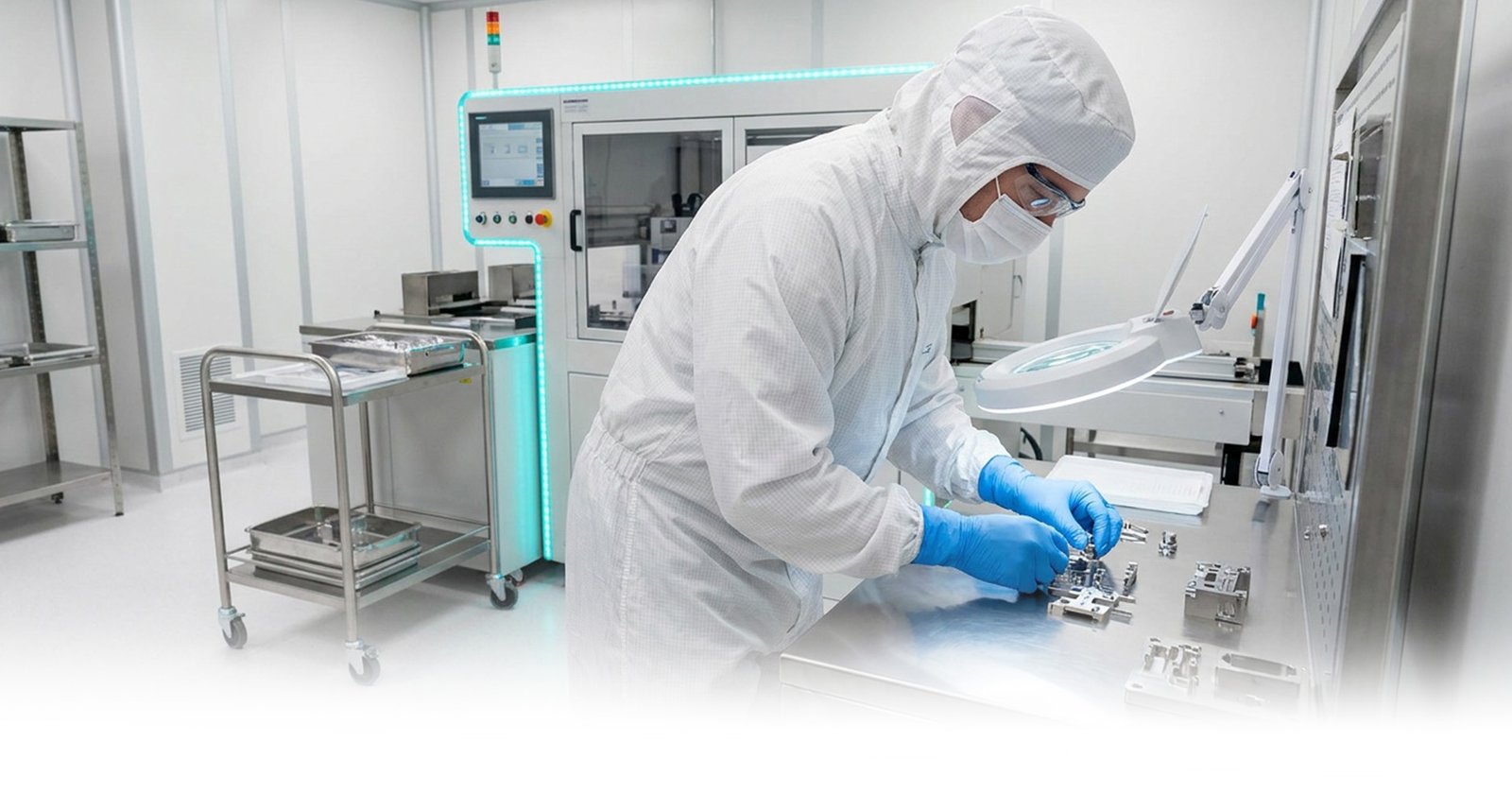
Cleanroom PPE isn’t just a safety requirement — it’s a contamination control measure. The right garments, gloves, and eyewear reduce the particles and contaminants a person introduces into the environment simply by being in it, while also protecting personnel from whatever they’re working with. Getting this right means the fit, the material, and the classification all need to match the actual cleanroom class and process, not just meet a generic checklist.
Furniture: Built for Cleanability, Not Just Function
Furniture in a controlled environment carries more responsibility than furniture anywhere else in a facility. Stainless steel worksurfaces, ergonomic workstations, gowning benches, carts, and seating all have to hold up to repeated cleaning and disinfection cycles without breaking down, corroding, or generating particles of their own. Beyond material selection, furniture placement and configuration directly shape workflow — how people move, gown, and work within the space either supports contamination control or undermines it.
Static Control: The Threat You Don’t See Until It’s a Problem
Static charge builds quietly on non-conductive materials and product surfaces throughout assembly and packaging. Left unaddressed, it pulls particles onto product surfaces and damages ESD-sensitive components — often without any obvious warning sign until an inspection station starts flagging contamination that wasn’t there a moment before.
Ionizing fans, bars, and guns neutralize that charge before it becomes a yield problem, delivering a balanced stream of ions across a work zone to keep particles from being drawn onto product. Paired with particle traps and monitoring systems, static and particle control rounds out the picture: it’s not enough to keep the room clean if an invisible electrical charge is actively working against you.
Why Single-Sourcing Matters
Coordinating a cleanroom build, PPE program, furniture layout, and static control system across separate vendors creates gaps — in compatibility, in accountability, and in whether anyone is actually looking at how all four pieces work together as one system. When a single partner understands your cleanroom’s design intent, they can recommend PPE, furniture, and static control solutions that were chosen with that intent in mind, not selected independently and hoped to fit.
That’s the approach we take with every customer: understand how the cleanroom actually operates, then build out the protection, the workspace, and the contamination control around that reality. Every environment has its own risks, workflows, and compliance requirements — the goal is a controlled environment where cleanliness, comfort, and compliance reinforce each other instead of competing.
The Bottom Line
When your room, your people, your workspace, and your contamination control are sourced and built to work together, product integrity follows. That’s the case for treating PPE, furniture, and static control as part of the cleanroom decision — not as afterthoughts to it.
Let’s talk about outfitting your controlled environment from the room out >>>