
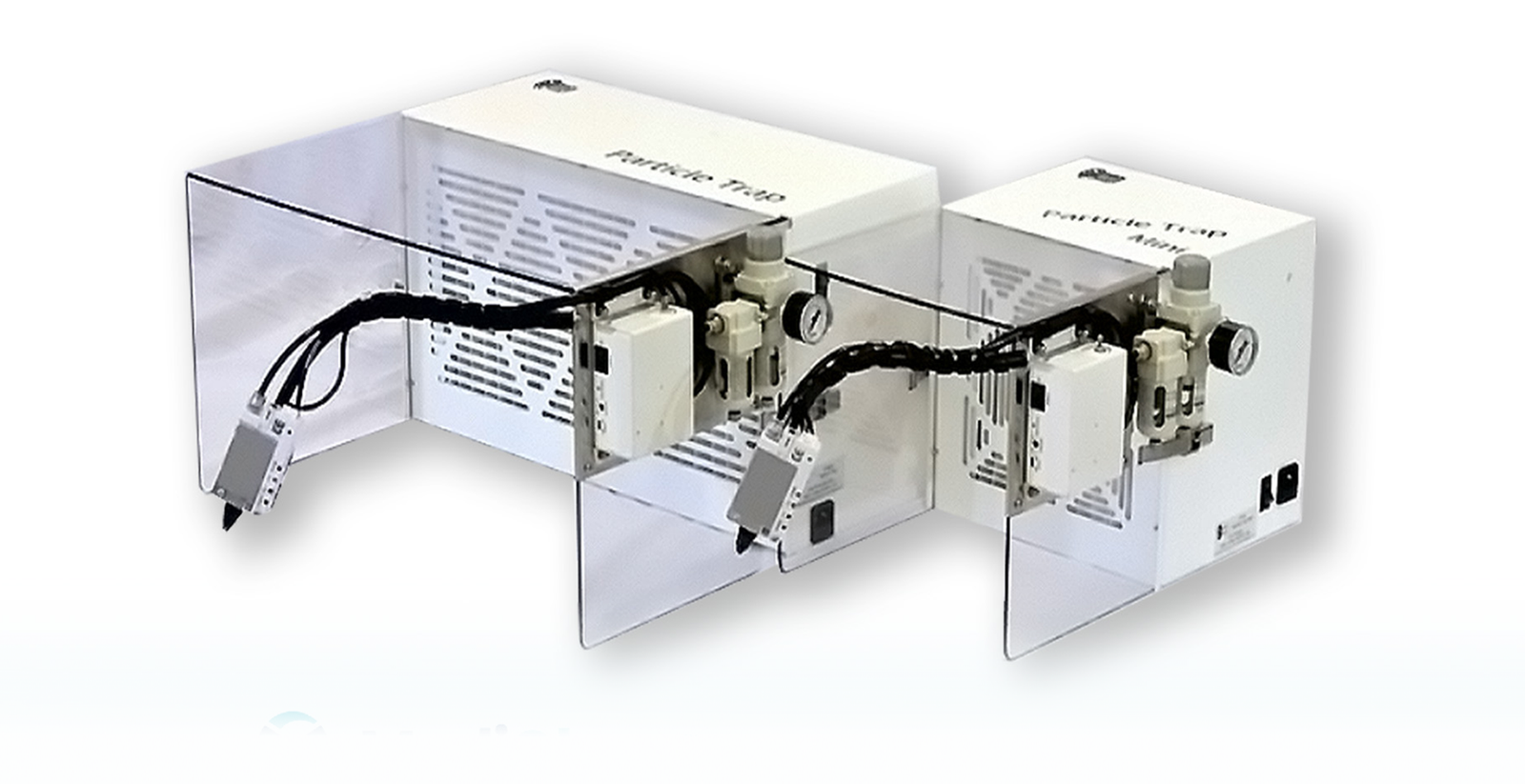
Particle Traps
What Is a Particle Trap?
A Particle Trap is a source-capture contamination control system designed to solve one of the most persistent challenges in cleanroom and controlled-environment manufacturing: when you blow particles off a product or component, where do those particles go? Conventional compressed-air cleaning simply redistributes contamination within your cleanroom—particles become airborne, settle on adjacent products, fall onto workbenches, or are carried onto personnel, ultimately finding their way back onto your critical surfaces. MediClean supplies Particle Trap systems from Static Clean International (SCI), the industry leader in contamination control for medical device manufacturing, packaging, electronics, and semiconductor applications.
How Particle Traps Work
Particle Trap systems use negative pressure combined with a Pre-Filter and HEPA filter combination to permanently capture particles as they are blown off products, components, trays, and packaging materials. Clean, HEPA-filtered air is returned directly into the cleanroom or laboratory—eliminating the need for external ductwork or the loss of conditioned air from the facility. The result: particles are trapped inside the system, permanently removed from your process and environment.
Particle Trap Products Available from MediClean
- Particle Trap 6000 (PT6000): Full-size source-capture system for high-throughput cleaning in cleanrooms and controlled environments
- Particle Trap Mini (PT Mini): Compact source-capture system for workbench use, ideal for cleaning medical devices, optics, and packaging materials
- Particle Trap Cube (PT Cube): Compact benchtop unit using static neutralization, adjustable high-velocity compressed air nozzles, and MERV11 filtration in one self-contained unit
Applications in Medical Device Manufacturing
Particle Traps are used throughout medical device and packaging manufacturing to reduce foreign matter (FM) and improve production yields.
- Cleaning molded plastic components and packaging trays before assembly
- Removing particulate from device housings prior to labeling or sealing
- Cleaning optics, lenses, and precision components
- Pre-packaging cleaning of sterile barrier trays and pouches
- Reducing rework and rejection rates caused by FM contamination
Why Source Capture vs. Conventional Blow-Off?
Traditional ionizing air guns and blow-off nozzles neutralize static charges and dislodge particles—but without source capture, particles remain in your environment. Source capture systems like the Particle Trap permanently remove contamination from the process, providing a measurable improvement in cleanroom cleanliness, yield, and product quality.
Frequently Asked Questions (FAQ)
Common questions about Particle Traps from medical device manufacturers.
Q: What is the difference between the Particle Trap 6000 and the Particle Trap Mini?
A: The PT6000 is a larger, full-size system designed for higher-volume cleaning applications. The PT Mini is a compact, benchtop unit that offers the same HEPA-filtered source-capture technology in a smaller footprint for individual workstations.
Q: Do Particle Traps require external ductwork?
A: No. Particle Trap systems return HEPA-filtered air directly into the cleanroom or lab environment, eliminating the need for external ductwork and preventing the loss of conditioned cleanroom air.
Q: What filters do Particle Trap systems use?
A: Particle Trap systems use a Pre-Filter and HEPA filter combination. Quick-change filters are available to minimize maintenance downtime. Replacement filters and consumables are available through MediClean.
Q: Are Particle Traps suitable for use with ionizing air guns?
A: Yes. Particle Trap systems are designed to be used in conjunction with ionizing air guns and nozzles. The Particle Trap captures the particles dislodged by the ionized airflow, preventing recontamination of your cleanroom environment.
Q: What industries use Particle Trap contamination control systems?
A: Particle Traps are used in medical device manufacturing, pharmaceutical packaging, electronics assembly, semiconductor fabrication, and optical manufacturing—any environment where foreign matter control is critical to product quality and yield.